The Jacket Length Question That Decides Every Fall Outfit for an Apple Shape
Quick Answer: For an apple-shaped frame, the two jacket lengths that reliably work are cropped at the natural waist or longline ending at mid-thigh or below. The length to avoid is the one that ends at the widest part of the midsection - typically hitting right at or just below the belly - because a horizontal hem draws the eye exactly there. Wearing a longer jacket open creates two strong vertical lines down the front, which is the single most useful outerwear trick available for this shape.
You try on four jackets, three feel wrong, and you cannot articulate why. The fabric is fine, the size is right, and the difference is entirely in where the bottom edge lands.
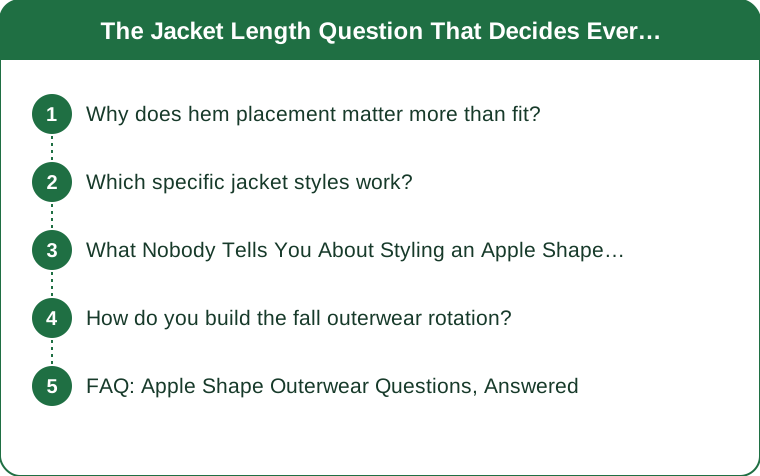
Why does hem placement matter more than fit?
A hem is a horizontal line, and horizontal lines draw the eye. Wherever a jacket ends, the viewer’s attention stops there and reads that point as a width marker. On an apple shape, where circumference is greatest through the midsection, a hem landing in that zone puts a visual emphasis exactly where you probably do not want one.
The two safe zones are above and below the widest point. Ending at the natural waist - the narrowest part of the torso, above the fullest part of the abdomen - marks a narrower measurement. Ending at mid-thigh or below clears the midsection entirely and marks a point where the silhouette has already narrowed again.
The problem zone is roughly hip-bone height on most apple frames. That is where a great many standard jackets end, which is why so much off-the-rack outerwear feels subtly wrong on this shape and why it is not a fit issue you can size your way out of.
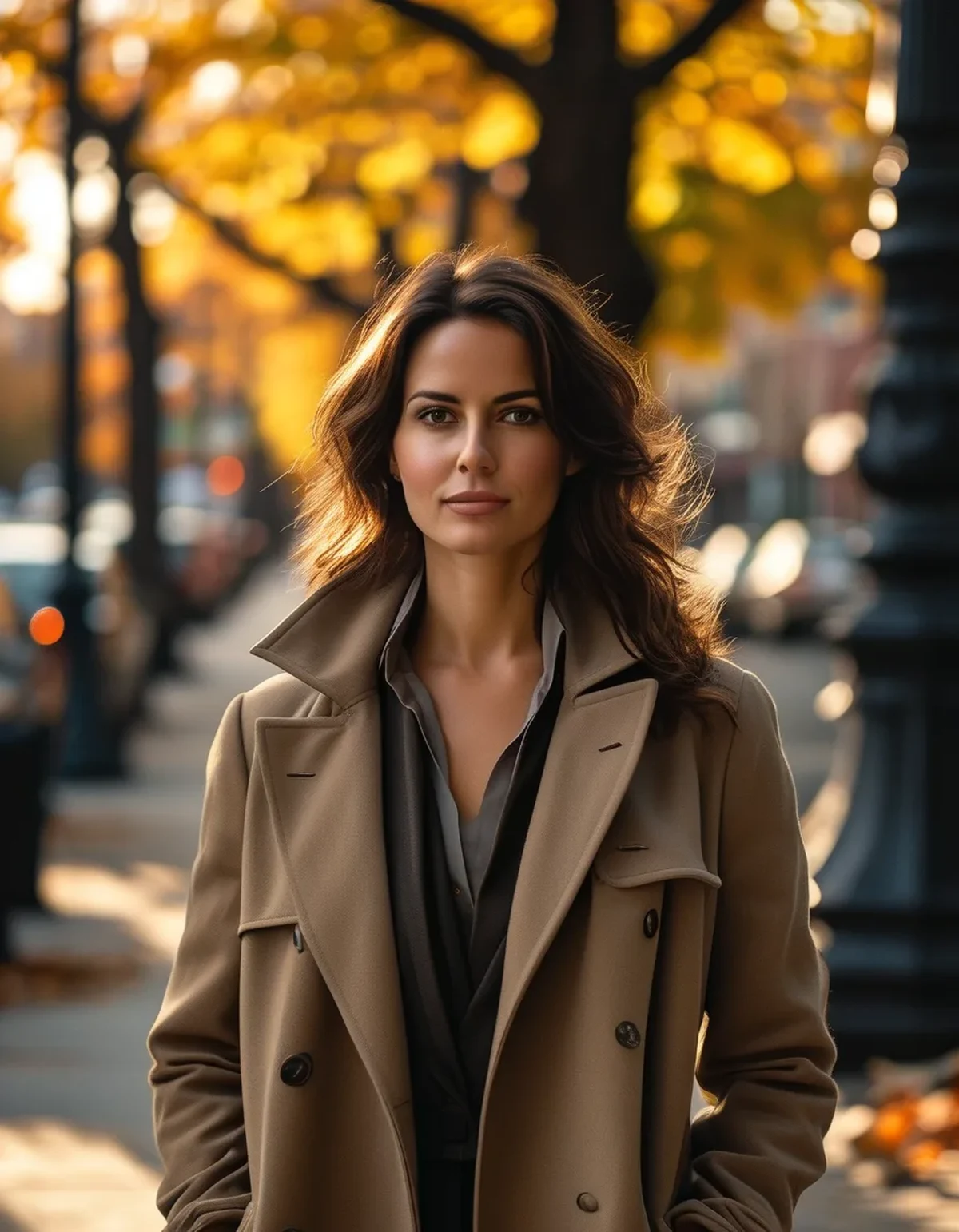
Vertical lines counteract horizontal ones. An open jacket creates two long uninterrupted vertical edges running the full length of the body, and the eye travels along them rather than stopping at the hem. This is why the same jacket can look completely different open and closed - and it is why longline outerwear is worn open in nearly every well-styled photograph you have seen of it.
And the exposed center column matters too. The strip of top visible between the open jacket fronts reads as a narrow vertical panel, particularly when it is a darker or more fitted piece than the jacket.
Which specific jacket styles work?
Longline coats and dusters ending mid-thigh to knee. The most reliable category. Worn open they give you the two verticals; the length clears the midsection entirely; and they read polished with almost anything underneath.
Cropped jackets ending at the natural waist. Denim jackets and cropped blazers cut to end above the fullest part of the abdomen work well, particularly over a longer top that continues past the jacket hem. That layered edge creates depth rather than a single hard line.
Open-front cardigans and long knits. The soft version of the same principle, and often the most comfortable for daily wear in transitional weather. Look for ones with enough weight to hang straight rather than cling.
V-neck and lapel structures over crew necks. A lapel or open collar creates a vertical at the chest that continues the line upward, drawing the eye toward the face and away from the middle.
Styles to approach carefully: anything with a defined horizontal band at the hem - elasticated bomber hems, drawcords pulled tight at the belly, or peplum details sitting at the widest point. Each of these creates a strong horizontal exactly where you are trying not to have one.
And be careful with boxy, cropped puffers, which combine a horizontal hem at the midsection with substantial volume. If you want a puffer, longline versions are considerably easier to wear on this shape.
What Nobody Tells You About Styling an Apple Shape in Fall
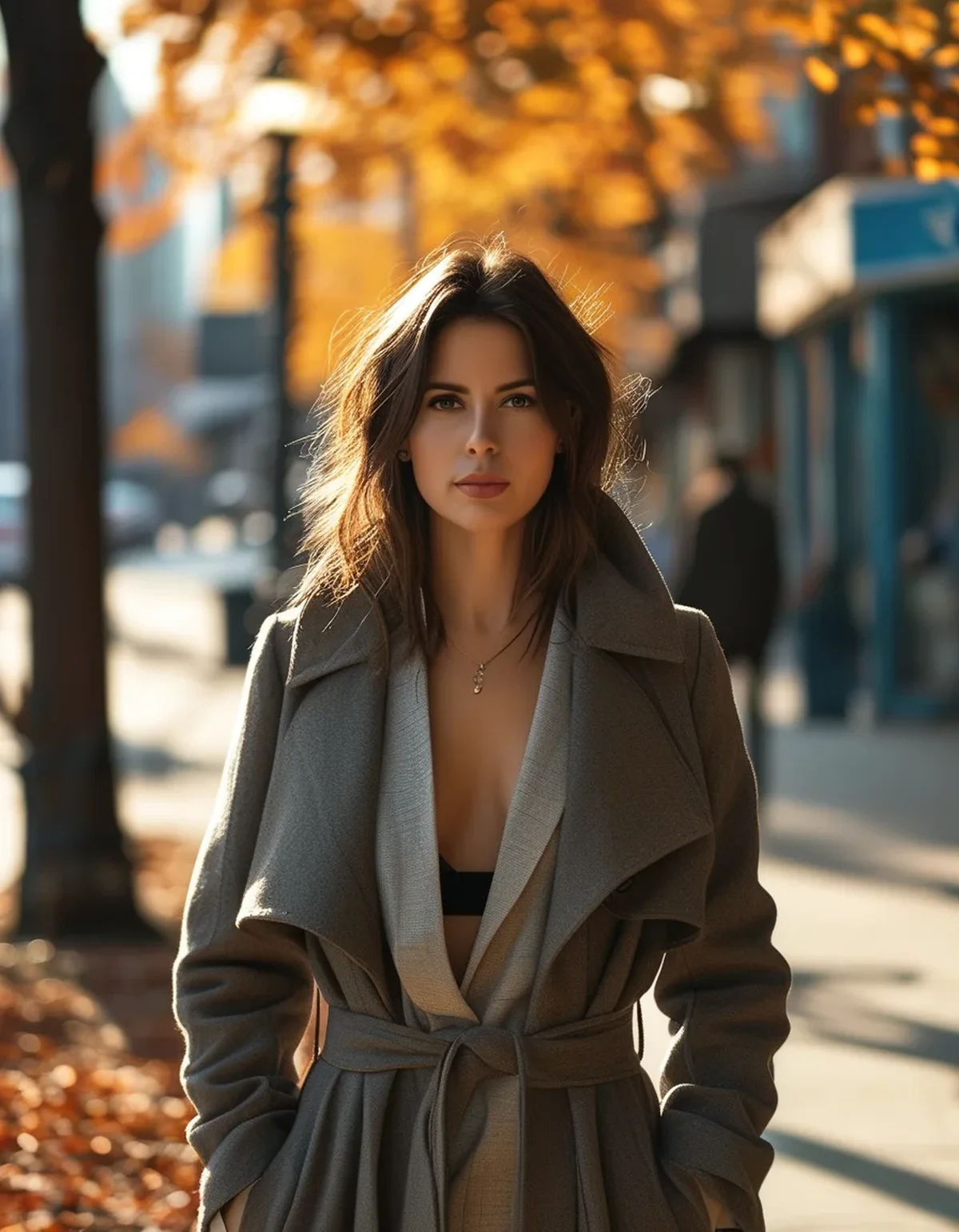
Closed jackets need a different strategy entirely. In genuinely cold weather you will zip up, and the two-vertical trick disappears. That is when length does all the work - a knee-length closed coat still reads long, while a closed hip-length jacket does not. Buy your coldest-weather coat long.
The top underneath matters as much as the jacket. A fitted, darker top under an open jacket creates a narrow vertical column. A voluminous top under the same jacket fills the opening and eliminates the effect, which is why the exact same coat can work brilliantly one day and not the next.
Apple shapes usually have great legs and often hide them. The proportional strength of this shape is the lower body, and a long jacket over a slim bottom takes advantage of that directly. Ankle-length or slim leggings under a longline coat is one of the most consistently effective fall combinations available.
Structure beats drape at the shoulder. A defined shoulder line broadens the top of the silhouette slightly, which balances the midsection. Sloped, unstructured shoulders on a soft coat can make the middle look proportionally wider than it is.
Length rules are proportional, not absolute. Mid-thigh on a 5-foot-2 frame is a different measurement than on a 5-foot-9 frame, so use where it lands on your body rather than the inches on a size chart. Petite-specific outerwear exists mainly because this one variable goes wrong so often.
And the belt question has a real answer. If you belt a coat, place it at the natural waist - the narrowest point - and keep it loose enough to create shape rather than compression. A belt pulled tight at the widest point emphasizes exactly what a hem there would.
How do you build the fall outerwear rotation?
Start with one longline open-front piece. If you buy one thing, this is it. A mid-thigh to knee-length open coat or duster in a dark neutral will work with nearly everything else you own and covers the widest range of temperatures.
Add one cropped jacket at the natural waist. A denim or cropped utility jacket for warmer days, worn over a top that extends past the jacket hem.
Then one closed-weather coat, and make it long. This is where people economize and regret it. The coat you wear zipped in November through February should end at or below the knee.
Keep the underneath layer consistent. Two or three fitted, darker tops that work as the center column mean any of the three jackets works instantly, without the daily experiment.
Test everything in a full-length mirror, both open and closed. Most jacket disappointments happen because it was tried on open in a store and worn closed in real life, or the reverse.
And take a photo. A mirror shows you what you look for; a photograph shows you the proportions the way other people see them, and it is remarkably effective at revealing which hem length is actually working.
FAQ: Apple Shape Outerwear Questions, Answered
What jacket length is most flattering for an apple shape?
Either cropped at the natural waist, above the fullest part of the abdomen, or longline ending at mid-thigh or below. Avoid hems that land at the widest part of the midsection, since a horizontal line draws the eye directly to that point.
Should apple shapes wear jackets open or closed?
Open whenever the weather allows - two long vertical edges running down the front draw the eye lengthwise rather than stopping at the hem. For genuinely cold weather when you will zip up, choose a coat that ends at or below the knee so length does the work instead.
What should I wear under an open longline coat?
A fitted, darker top creates a narrow vertical column between the coat fronts and reinforces the effect. A voluminous top fills that opening and cancels most of the benefit of wearing the coat open.
Can apple shapes wear belted coats?
Yes, if the belt sits at the natural waist - the narrowest point of the torso - and is loose enough to create shape rather than compress. A belt cinched at the fullest part of the midsection emphasizes exactly what you were trying to avoid.
TL;DR:
- A jacket hem is a horizontal line that marks width wherever it lands, so placement matters more than fit for an apple shape.
- The two reliable lengths are cropped at the natural waist or longline at mid-thigh and below; avoid hems at the fullest part of the midsection.
- Wear longer jackets open - the two vertical front edges draw the eye lengthwise instead of stopping it at the hem.
- Keep a fitted, darker top underneath as the center column; a voluminous one cancels the effect entirely.
- Buy your closed-weather winter coat long, since zipping up removes the vertical trick and leaves length doing all the work.
Three jackets - one longline, one cropped at the waist, one long winter coat - and a couple of fitted tops underneath. That combination removes almost every fall outfit decision before you make it.
Keep Reading
This article is for general informational and styling purposes only. Fit, sizing, and product availability may vary.
