Why Every Fall Jacket Adds Width on an Apple Shape — and Which Ones Don't
Quick Answer: Most fall jackets add width at an apple shape’s widest point because they’re cut with the volume at the waist and they stop right there. Look for jackets that hit below the widest point — mid-thigh or longer — that open in a clean vertical line, and that carry their structure in the shoulder rather than the body. A jacket that ends at your midsection will draw the eye to your midsection no matter what it’s made of.
The summer wardrobe was solved. Then the temperature dropped fifteen degrees and everything you own that has sleeves makes you look wider.
This isn’t in your head and it isn’t about the size. It’s about where jackets are engineered to end.

Why does jacket length matter more than jacket size?
Because the eye reads a hemline as a horizontal stop, and a horizontal stop is where attention lands.
An apple-shaped frame carries fullness through the midsection with typically slimmer legs and a proportionally narrower hip. A jacket that ends at the natural waist or just below puts a hard horizontal line exactly at the widest point and then stops. The line says: here, look here.
The same jacket in a larger size doesn’t fix it. It’s still ending in the same place relative to your body, just with more fabric. Sizing up is the most common response and the least effective one.
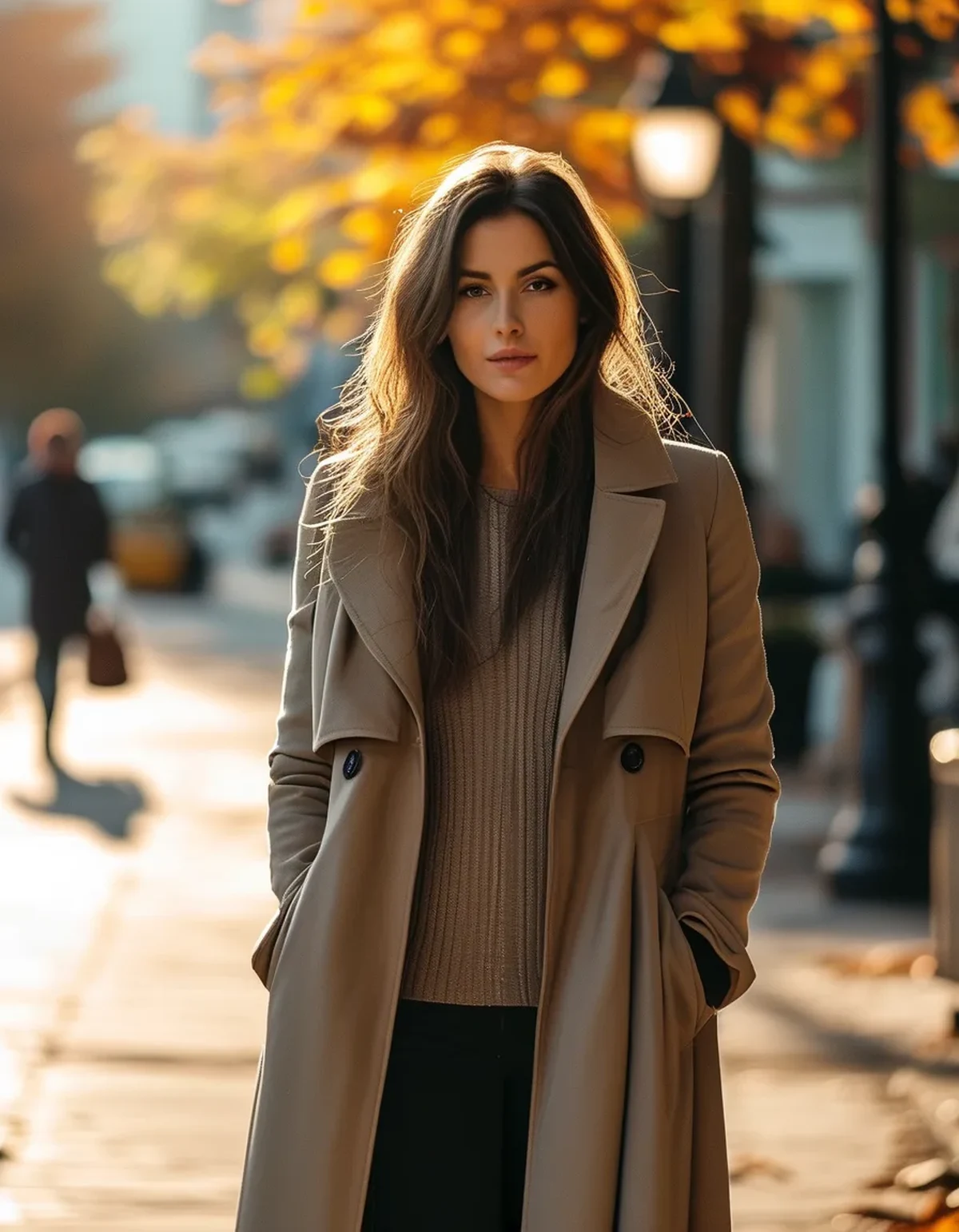
The geometry that works: end the jacket below the widest point, so the eye travels past it. Mid-thigh, high-hip on a longer torso, or full length. The vertical run of the open jacket becomes the dominant line instead of the horizontal hem.
This is why a longline coat frequently looks better on an apple shape than a cropped moto jacket does, even when the cropped jacket is objectively the more flattering cut on someone else.
What does open versus closed actually do?
An open jacket creates two vertical lines running down your torso — the two front edges. Vertical lines break up horizontal width, which is the entire mechanism.
A closed jacket removes those lines and presents one continuous surface, which reads as one continuous width. Same jacket, completely different effect.
So the practical rule for fall: buy jackets you intend to wear open, and make sure they look correct that way. That means checking:
- Does it hang straight when open, or does it flare out at the hem?
- Are the front edges clean — no bulky facings, no wide contrast plackets that create their own horizontal interest?
- Is what’s underneath doing work? An open jacket exposes a vertical column of whatever you’re wearing beneath. A darker, more fitted base under an open lighter jacket is the classic version of this and it works.
For genuinely cold days when open isn’t an option, the answer is a belted closure rather than a zipped one — a belt tied at the narrowest point you have creates definition where a zip creates a tube.
Where should the structure be?
In the shoulder. Almost always.
A jacket with a defined shoulder — a real seam sitting at your shoulder point, some structure in the sleeve head — establishes width at the top of your frame. When the shoulder is the widest visual point, everything below reads narrower by comparison. This is the oldest trick in tailoring and it’s genuinely effective.
What to avoid: volume in the body. Anything that adds fabric around the ribs and waist — deep gathers, a dropped shoulder that lets the whole garment hang wide, heavy quilting through the midsection — puts the volume where you already have it.
This makes puffer jackets specifically tricky, because quilting adds even loft everywhere and the horizontal quilt lines are, unhelpfully, horizontal. If you want a puffer, look for vertical baffles rather than horizontal channels, and a longer length. Both details exist and are worth searching for.
The other structural detail worth caring about: a collar that opens into a V. A notch lapel, a shawl collar left open, or a jacket worn with a scarf that creates a vertical drape. It extends the vertical line upward and it’s why an open blazer works so reliably.
Myth vs Fact: Apple Shape Outerwear
Myth: Dark colors are the solution. Fact: Dark colors help slightly and structure helps enormously. A well-cut light coat beats a badly-cut black one. Relying on color alone is how people end up with a closet of black jackets that all have the same problem.
Myth: You should hide the midsection completely. Fact: Fully hiding it — a shapeless tent — usually adds visual width, because the eye assumes the widest point of the garment is the widest point of you. Skimming beats hiding.
Myth: Belts are off-limits. Fact: Belts work when placed at the narrowest point available, which on many apple shapes is higher than the natural waist — under the bust or just below the ribs. A belt at the true widest point is the problem, not belts in general.
Myth: Oversized is always safer. Fact: Oversized works when the shoulder is still defined and the length is long. Oversized and cropped is the specific combination that fails.
Myth: You can’t wear a cropped jacket at all. Fact: You can, over a long, lean base — a maxi dress, a long tunic, full-length slim trousers. The cropped jacket stops being the only horizontal line when there’s a strong vertical running the full height of the outfit.
What’s the actual fall shopping list?
Concretely, five pieces that reliably work, in rough order of usefulness:
1. A longline open coat hitting mid-thigh or below, in a fabric with enough weight to hang straight. This is the single highest-return outerwear purchase.
2. An unstructured blazer with a defined shoulder, worn open, hitting at high hip or lower. Bridges work and weekend.
3. A long cardigan or duster in a knit that drapes rather than clings. The soft version of the same geometry, and the one you’ll reach for on 62°F mornings.
4. A vertical-baffle puffer for genuinely cold days, in the longest length you’ll tolerate.
5. A large scarf. Not technically outerwear, but a scarf hanging in two long vertical panels does more shape work than most jackets and costs a fraction as much.
What to try in a fitting room: put it on, leave it open, and look at yourself from six feet back rather than up close. Apple-shape outerwear decisions are made at distance, because that’s the only place you can see the whole line at once. Up close, everything looks fine.
TL;DR:
- Jackets that end at your widest point draw the eye there. Length matters more than size.
- Aim for mid-thigh or longer, and buy jackets you’ll wear open — the two front edges are vertical lines that break up width.
- Put the structure in the shoulder, never volume in the body. Vertical baffles over horizontal quilting.
- Belt at the narrowest point you have, which may be higher than the natural waist.
- Cropped jackets work over a long lean base, not over a mid-length one.
Judge every jacket from six feet back with the front open. That’s the only view that tells you the truth.
Keep Reading
This article is for general informational and styling purposes only. Fit, sizing, and product availability may vary.
