Why Your Shape Changed at 45 - and Which Dressing Rules Change With It
Quick Answer: Falling estrogen during perimenopause shifts fat storage from the hips and thighs toward the abdomen, and it happens even when body weight stays the same. Practically, that means your waist measurement can grow while your hip measurement does not, which breaks any garment sized on a waist-to-hip relationship - trousers, dresses, and fitted jackets in particular. The three rules that change: buy bottoms by waist and tailor the hip rather than the reverse, move to structured shoulders and defined waists placed above the fullest point, and abandon the tucked-in rule you have followed since your twenties.
Nothing about your styling instincts got worse. The measurements they were built on moved, and nobody sends a memo. Here is what actually changed and which specific rules need adjusting.

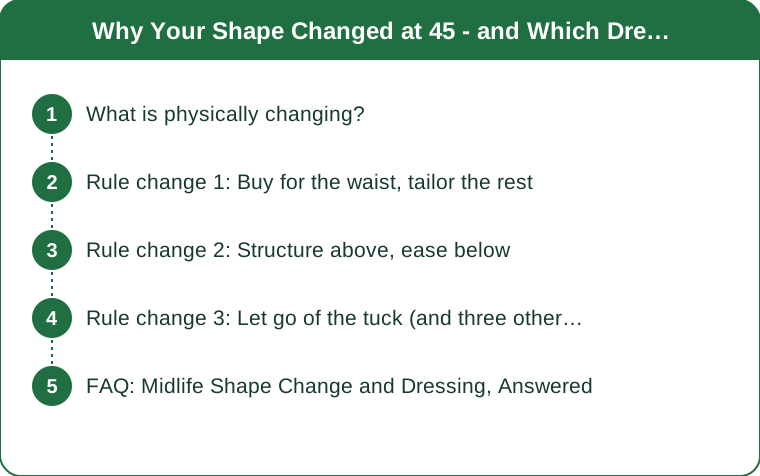
What is physically changing?
Estrogen influences where the body stores fat. Through the reproductive years, higher estrogen favors storage in the hips, thighs, and buttocks. As estrogen falls through perimenopause and into menopause, storage preference shifts toward the abdomen, including visceral fat around the organs.
This happens independently of weight change. Studies tracking women through the menopausal transition consistently find increased abdominal fat and waist circumference even in women whose scale weight is stable. You can be exactly the same weight and a different shape, which is disorienting precisely because the usual explanation - you gained weight - does not apply.
Muscle mass declines at the same time. Age-related muscle loss accelerates without resistance training, and less muscle means a lower resting metabolic rate and a softer overall line. This part is the most modifiable of everything on this list.
Rib cage and posture change too. Many women notice their bra band size increases in their forties and fifties. Some of that is fat distribution; some is postural change and reduced thoracic mobility, which alters how everything sits on the torso.
And bloating becomes more variable. Hormonal fluctuation during perimenopause is erratic rather than steadily declining, and digestive changes are common. The practical result is a waist measurement that varies more day to day than it used to, which matters enormously for how you should buy fitted clothing.
Rule change 1: Buy for the waist, tailor the rest
The old rule was to buy trousers for the hips and take in the waist, because for most pre-menopausal bodies the hip was the widest measurement and the harder one to alter.
When the waist grows and the hips do not, the arithmetic reverses. You now often need the larger size for the waist, which leaves excess through the seat and thigh. That is a much easier alteration than letting out a waistband - a tailor can take in a side seam and a back rise for a modest cost, and the result fits properly rather than approximately.
Or skip tailoring and change the garment category. Elasticated backs, drawcord waists, wrap styles, and pull-on ponte trousers all accommodate a variable waist without any alteration at all. These have improved enormously in the last few years and no longer read as a compromise.
Rise is now your most important trouser measurement. A rise that sits at or just above the natural waist skims the fullest point. A mid-rise that lands directly on the abdomen at the widest spot creates a horizontal line exactly where you do not want one, and it is the reason a pair can feel wrong without any obvious fault.
Measure again, honestly, twice a year. A large share of fit frustration in midlife comes from buying to a number that was accurate three years ago. This is a five-minute task with a very high return.

Rule change 2: Structure above, ease below
Structured shoulders do more work now than they used to. A jacket with a defined shoulder line establishes the widest point at the top of the body, which balances a fuller midsection far more effectively than anything you can do at the waist itself. This is the single highest-return garment change.
Define the waist above the fullest point, not at it. A belt, a wrap tie, or a seam placed just under the bust creates a waist that reads as a waist, while a belt at the natural waist on a fuller midsection emphasizes the exact circumference you were trying to soften.
Choose fabrics with body. Ponte, structured cotton, mid-weight crepe, and heavier jersey hold their own shape and skim. Thin clingy jersey and lightweight silk follow every contour, which is why an expensive silk shell can look worse than a cheaper structured one.
Vertical lines and open necklines both work by lengthening. An open V or scoop, a long open cardigan, or a column of a single color all draw the eye up and down rather than across. None of this is about hiding - it is about which direction the eye travels first.
And length matters on layers. A jacket or cardigan that ends exactly at the fullest point of the abdomen draws a horizontal line there. Ending either above the waist or well below the hip avoids it. This one adjustment fixes an enormous number of outfits that felt off for no identifiable reason.
Rule change 3: Let go of the tuck (and three other habits)
The tucked-in top is the rule most worth retiring. It was excellent advice when your waist was your narrowest measurement. On a fuller midsection it creates bunching at the waistband and a hard horizontal line. A front tuck, a half tuck, or an untucked top with a defined shoulder does the same job of showing shape without the bulk.
Second habit: buying the same size in everything. Vanity sizing has drifted and your proportions have changed. The size on the label is now less informative than it has ever been, and refusing to size up in one category while your measurements say otherwise is how you end up with a closet of things you do not wear.
Third habit: judging fit on a bloated day. Perimenopausal bloating is more variable than cycle bloating was, and trying clothes on at your fullest produces a wardrobe that is loose most of the time. Try on mid-week, mid-morning, and buy for the middle of your range with fabrics that accommodate the top of it.
Fourth habit: skipping the bra fitting. Band size changes are extremely common in this decade, and a band that no longer fits changes the position of the bust, which changes where your waist appears to be, which changes how every top hangs. It is the least glamorous fix and one of the most effective.
And one addition rather than a subtraction: resistance training twice a week. This is not a styling tip, but it is the only intervention on this page that changes the underlying line rather than dressing it. Muscle retention through the menopausal transition affects strength, bone density, metabolic health, and posture - and posture affects how every single garment sits.
FAQ: Midlife Shape Change and Dressing, Answered
Why is my stomach bigger when my weight has not changed?
Falling estrogen shifts fat storage toward the abdomen, so the same body weight redistributes. Loss of muscle mass and postural change contribute as well. This is a documented feature of the menopausal transition, not a sign you have done something wrong.
What trouser rise works best for a fuller midsection?
A high rise that sits at or just above the natural waist, because it skims past the fullest point rather than cutting across it. Mid-rise styles that land directly on the abdomen tend to roll and create a horizontal line.
Should I stop wearing fitted clothes?
No - oversized everything reads as larger, not smaller. The better move is fitted where you are narrowest, usually the shoulders, upper back, and lower leg, with skim rather than cling through the middle. Structure beats volume.
Does exercise change abdominal fat distribution in menopause?
Resistance training and general activity meaningfully support muscle retention, metabolic health, and visceral fat levels, though no exercise targets fat loss from a chosen area. Two resistance sessions a week is the most commonly recommended starting point and the one with the broadest benefits.
This is general information, not medical advice. If shape change is rapid, accompanied by other symptoms, or affecting your quality of life, a conversation with a doctor about perimenopause is worth having.
TL;DR:
- Falling estrogen shifts fat storage toward the abdomen, so your waist can grow while your hips do not - even at a stable weight.
- Buy bottoms for the waist and tailor the seat, or switch to drawcord, elasticated, and wrap styles that accommodate a variable waist.
- Structure the shoulders, define the waist above the fullest point, and avoid layer hems that end exactly at the widest part.
- Retire the full tuck, re-measure twice a year, get a bra fitting, and stop judging fit on a bloated day.
- Two resistance sessions a week is the only item here that changes the underlying line rather than dressing it.
Your styling instincts were built on a set of measurements that quietly changed. Update the measurements, adjust four rules, and the wardrobe starts working again - none of which requires becoming a different person.
Keep Reading
This article is for general informational and styling purposes only. Fit, sizing, and product availability may vary.
