Why Sports Bra Support Feels Different for an Apple-Shaped Frame
Quick Answer: Apple-shaped frames often carry more weight through the midsection with a fuller bust relative to a narrower hip line, which means band stability matters as much as cup support — a bra with a wide, non-riding band paired with wide straps distributes load better than cup size alone would suggest.
Most sports bra guides sort by cup size and activity level, but frame shape changes how a bra actually behaves during movement, and apple shapes deal with a specific mismatch that generic guides skip.

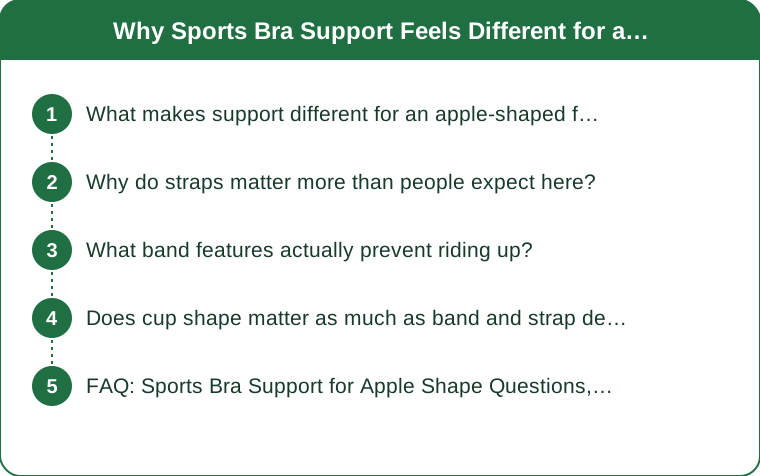
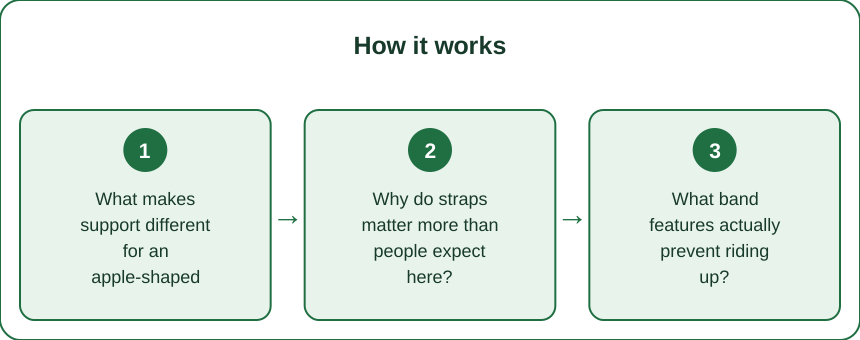
What makes support different for an apple-shaped frame?
A shorter, fuller torso relative to hip width means a standard band length may sit differently than it would on a longer-waisted frame, sometimes riding up during high-impact movement even at the correct band size. This isn’t a sizing mistake — it’s proportion, and it calls for band design as much as size.
A wider band (3+ inches) with grippy interior elastic resists riding up far better than a narrow band, regardless of cup size.
Why do straps matter more than people expect here?
Wide-set straps distribute bust weight across more shoulder surface area, reducing the digging that narrow straps cause when supporting more volume. Racerback or crossback strap styles, common in higher-support bras, also help keep the band from shifting during arm-heavy movement.
Strap width and placement often matter as much as the cup engineering itself for comfort through a full workout.

What band features actually prevent riding up?
Silicone grip strips along the bottom interior of the band, and a band that sits snug enough to stay put without a bra extender stretched to its last hook, both meaningfully reduce riding up. A band that’s only secure on the tightest hook has no room to tighten further as elastic naturally fatigues over time.
Buying with room to tighten the band over the bra’s lifespan extends how long it stays supportive.
Does cup shape matter as much as band and strap design?
It matters, but band and strap stability solve more of the actual movement problem than cup shape alone — a well-fitted cup on an unstable band still bounces and shifts. Prioritize band and strap fit first, then fine-tune cup style for comfort and coverage preference.
Encapsulation styles (molded cups) generally offer more structured support than compression-only styles for fuller busts, regardless of frame shape.
FAQ: Sports Bra Support for Apple Shape Questions, Answered
Is a wider band always better for an apple-shaped frame?
Generally yes for stability during movement, though comfort under the bust also depends on the band’s material and how well the underbust measurement matches.
Do racerback straps really make a noticeable difference?
Many people find they do, especially during overhead or high-impact movement, since they resist shoulder-strap slippage more than straight parallel straps.
How do you know when a sports bra’s band has fatigued and needs replacing?
If the band no longer stays snug on the loosest hook, or it needs the tightest hook just to feel secure, that’s a sign the elastic has fatigued and replacement is due.
TL;DR:
- Torso proportion, not just cup size, drives support needs on an apple-shaped frame
- Wide bands (3+ inches) with grip strips resist riding up better than narrow bands
- Wide-set or racerback straps distribute weight and reduce shoulder digging
- Prioritize band and strap stability first, then fine-tune cup style
The right support isn’t just about the cup number — proportion and band design carry more of the real work.
See It in Motion
Seen here: Crewneck Short Sleeve Workout T-Shirt — shop it on bubblelime.com
Keep Reading
This article is for general informational and styling purposes only. Fit, sizing, and product availability may vary.
