Apple Shape Dressing on a Bloated Day: What Actually Works
Quick Answer: On a bloated day, prioritise a soft, non-constricting waistband that sits either above or well below the point of discomfort, a top that skims rather than clings at the widest point, and a vertical opening such as an open jacket or cardigan. Avoid fixed waistbands, clingy jersey at the mid-torso, and anything with a horizontal seam across the midsection.
Most body-shape advice is written as though your measurements are constant. Anyone who deals with bloating knows the difference between a good day and a bad day can be several centimetres - and an outfit that works beautifully on one is genuinely uncomfortable on the other.
This is general information, not medical advice. Persistent or painful bloating, or a change in your usual pattern, is worth discussing with a clinician.

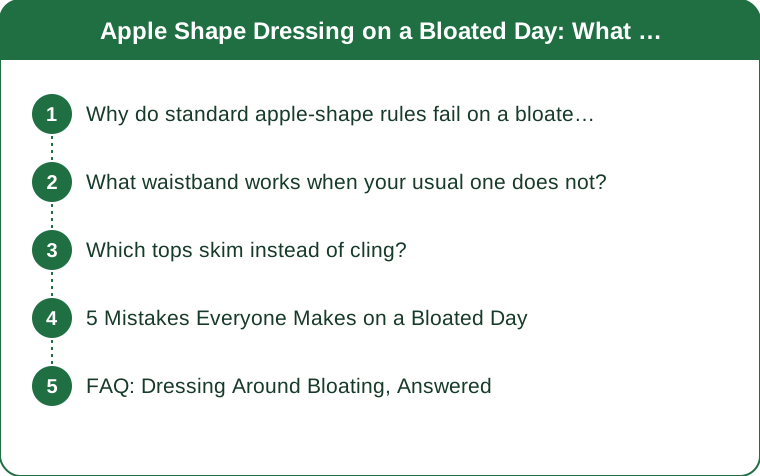
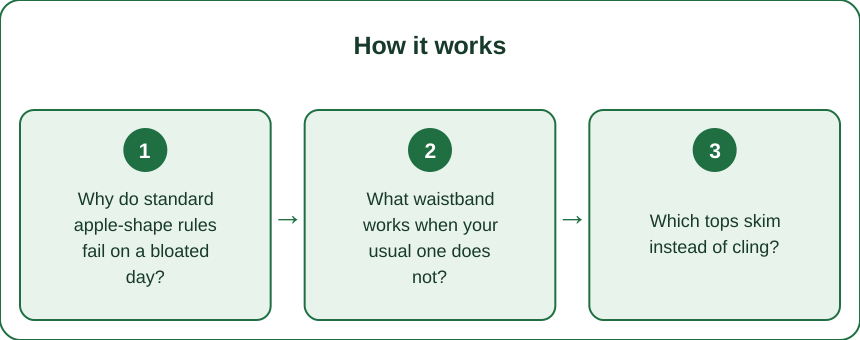
Why do standard apple-shape rules fail on a bloated day?
Because most of them are structural, and bloating is a variable.
The standard advice for an apple shape - define the waist, use a high rise, choose structured fabrics - works from a fixed set of proportions. On a bloated day, three of those assumptions break:
- The waist you were defining has moved. A belt placed at your usual narrowest point now sits at a point that isn’t narrow, which emphasises exactly what you were trying to soften.
- A high rise now sits at the fullest point. A waistband engineered to sit above the midsection can end up right across it, creating pressure and a visible line.
- Structured fabric has no give. The structure that flatters on a normal day becomes uncomfortable, and discomfort shows in how you hold yourself.
The reframe that helps: you don’t need a different body-shape strategy on these days. You need a soft version of the same strategy - the same silhouette, executed in fabrics and waistbands that move.
What waistband works when your usual one does not?
Waistband placement is the single decision that determines whether the day is comfortable.
Three placements, and when each works:
- Well above the fullest point - an empire or high-empire line, as in a wrap dress or a smock top with the seam under the bust. Nothing sits on the midsection at all. The most reliably comfortable option.
- Well below the fullest point - a low-rise or hip-slung trouser that sits on the hip bones. Works, but only with a top that covers the transition; otherwise it creates a visible over-spill line.
- Directly on the fullest point - the one to avoid entirely on a bloated day, regardless of how well it works normally.
Waistband construction, ranked:
- Fully elasticated, wide (5cm+) - distributes pressure, no digging
- Knit or ribbed waistband with no closure - the most forgiving
- Drawstring, worn loose - adjustable through the day, which is the real advantage
- Elasticated back, flat front - looks tailored, gives where it needs to
- Fixed woven waistband with a button - the least forgiving; save it for other days
A practical suggestion: own one trouser and one skirt specifically in the first category. Not as a compromise garment - as the one you actually reach for.

Which tops skim instead of cling?
The goal is fabric that touches at the shoulders and bust and then falls, rather than following the contour all the way down.
Fabrics that skim: crepe, ponte, thicker jersey, silk-feel woven, and anything with a slightly textured surface. Texture matters because it breaks up light and stops the fabric reading as a smooth contour map.
Fabrics that cling: thin viscose jersey, rayon, and anything very fine and drapey. These are excellent fabrics that happen to be the worst choice for this particular day.
Cuts that work:
- A slight A-line from under the bust - the empire principle applied to a top
- A soft V or scoop neckline, which draws the eye vertically and up
- Length that ends at the hip or below, not at the widest point of the midsection
- A blouson or gently gathered hem, which creates volume that isn’t your volume
Cuts to avoid: anything with a horizontal seam, band, or contrast panel across the mid-torso; a hem ending exactly at the fullest point; and boxy crops.
One underrated trick: a top in a slightly heavier fabric than you’d normally choose. Weight makes fabric hang rather than cling, and it’s the difference between two tops that look identical on a hanger.
5 Mistakes Everyone Makes on a Bloated Day
1. Sizing up in the same garment. A larger size in a fixed-waistband trouser is larger everywhere - including the hip and leg, where you didn’t need it. The result fits at the waist and bags elsewhere. Change the style, not the size.
2. Reaching for the biggest, loosest thing you own. Volume without structure adds width rather than hiding it. A skimming shape with defined shoulders reads far better than an oversized shape with none.
3. Wearing shapewear. Compression across a bloated abdomen increases discomfort and, for anyone with reflux or IBS, can genuinely make symptoms worse. It’s the intuitive response and the wrong one.
4. Abandoning the outfit at the last minute and wearing something you dislike. This is the third mistake that ruins the day rather than the outfit - you spend eight hours aware of what you’re wearing. Keep one complete, genuinely liked outfit set aside for exactly these days so the decision is already made.
5. Layering the wrong direction. An open cardigan or unbuttoned jacket creates two vertical lines and is the single most useful layering piece here. A closed, belted layer does the opposite.
FAQ: Dressing Around Bloating, Answered
Should I own a separate size for these days?
Rather than a second size, own two or three specific garments cut for it - a soft-waistband trouser, a skimming top, and an open layer. It’s cheaper than duplicating a wardrobe and works better.
Do fabrics with elastane help or hurt?
Help, in moderate amounts. A 3-5% elastane content in a woven fabric gives just enough movement without compressing. Very high elastane in a fitted knit is the opposite - it holds the contour.
What about dresses?
A wrap dress or an empire-line dress is arguably the easiest option available, because the waist seam sits above the variable area and the skirt falls away from it. A bodycon knit is the hardest.
Is bloating something I should be investigating?
Occasional bloating around meals, cycle, or specific foods is very common. Bloating that’s persistent, painful, comes with changes in bowel habit, or is new and unexplained is worth a clinician’s assessment rather than a wardrobe fix.
TL;DR:
- Keep the silhouette, soften the execution - same strategy, forgiving fabrics
- Waistband either well above or well below the fullest point, never on it
- Skimming fabrics with some weight and texture; avoid fine clingy jersey
- Change the style rather than sizing up, and skip shapewear entirely
- An open cardigan or jacket does more than any other single layering piece
- Keep one complete outfit set aside so the decision is already made
Your measurements aren’t a fixed number, and an outfit plan that assumes they are will fail roughly a third of the time. Two or three deliberately chosen pieces make those days unremarkable.
Keep Reading
This article is for general informational and styling purposes only. Fit, sizing, and product availability may vary.